Quick Answer / Key Takeaway
- Generating leads doesn't matter if you can't convert them into paying clients
- The gap between interest and purchase is where most revenue disappears
- Backend systems determine whether demand becomes income or just added stress
- Without integrated tools for follow-up and customer communication, you're leaving money on the table
- Success isn't about getting more leads—it's about having infrastructure that turns leads into clients consistently
Most coaches and consultants can generate interest in their services. That's rarely the problem.
The problem shows up after someone says "I'm interested"—and you have no clear way to move them from curiosity to payment. No calendar link. No follow-up sequence. No organized way to track who paid, who needs a reminder, or who fell through the cracks entirely.
You're not failing because you can't attract people. You're failing because you have no system to catch them once they arrive.
This article breaks down why lead generation without backend infrastructure creates chaos instead of revenue—and what actually needs to exist between "interested" and "paid client."
The Problem Isn't Your Lead Generation
Here's what usually happens:
A coach invests in marketing. They post consistently. They run ads. They speak on stages or show up in communities. People respond. Interest builds. Inquiries come in.
Then everything falls apart.
Why? Because the business has no process for what happens next.
Someone wants to book a session, but there's no calendar link. They send a DM or email asking how to pay, and it takes two days to respond because the founder is buried in client work. When payment finally happens through PayPal or Venmo, there's no confirmation email. No onboarding sequence. No clarity about what happens next.
The client paid, but they don't feel taken care of. And the founder has no idea if that person actually booked a time, received the intake form, or is sitting there wondering if they got scammed.
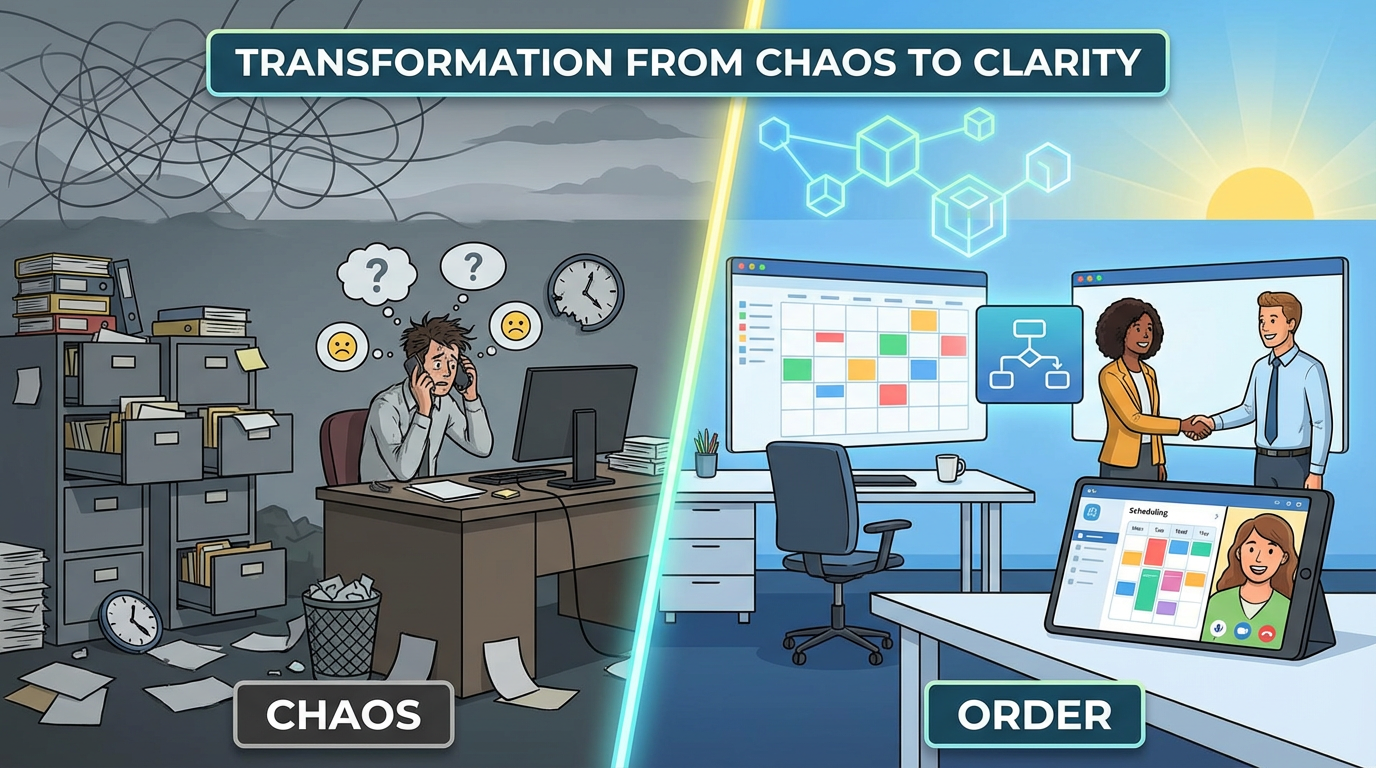
This is what drowning in your own success looks like.
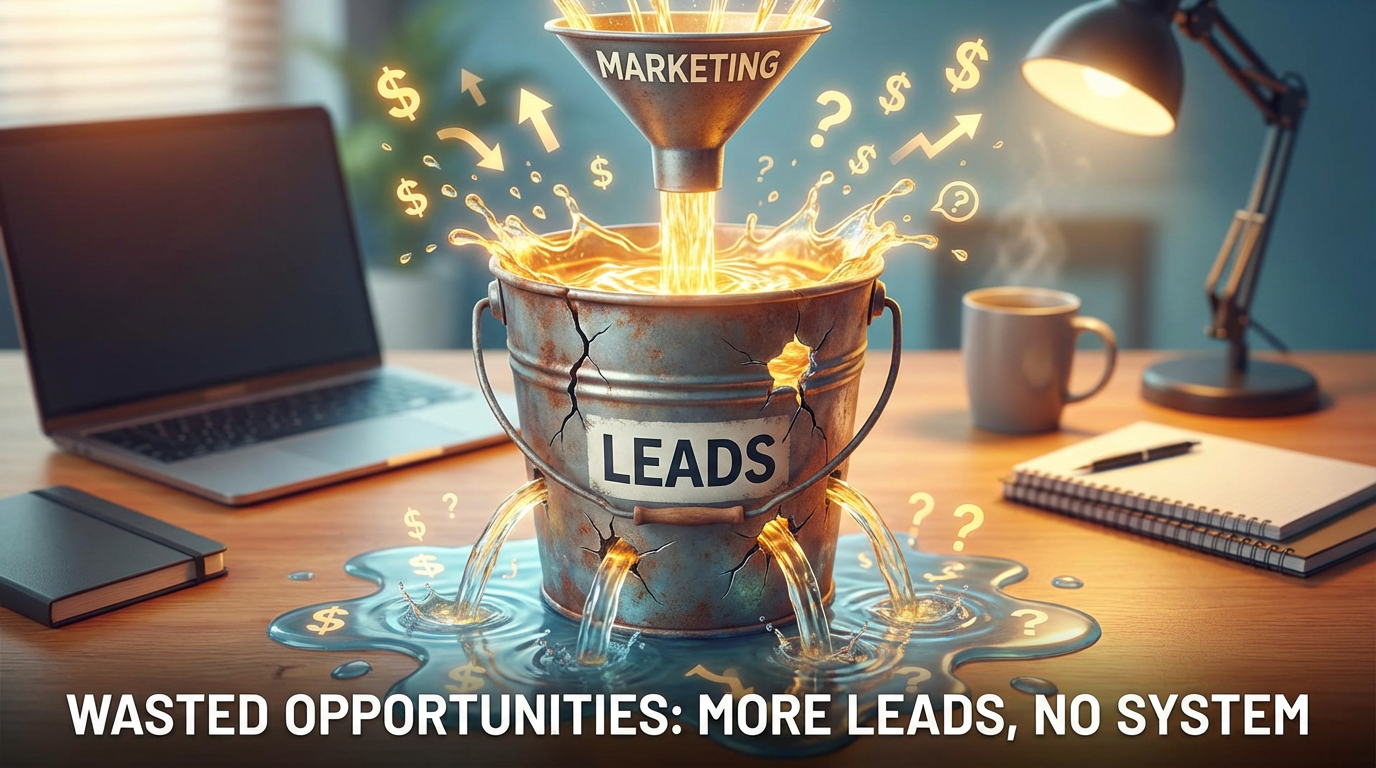
You did the hard part—you got people interested. But without systems to manage that interest, you're overwhelmed, your customers are confused, and a significant amount of revenue just disappears into the chaos.
What Founders Confuse: Demand vs. Capacity
Most founders think the goal is more leads.
But demand without infrastructure isn't growth. It's a crisis waiting to happen.
Here's the reality: if you can't handle the clients you already have, more marketing will only make things worse. You'll attract more people you can't serve. You'll create more confusion. You'll burn out faster.
The issue isn't that you need better lead generation. The issue is that your business has no operational backbone to convert those leads efficiently.
Think about it this way:
If 100 people express interest in your offer and only 10 become paying clients, you don't have a lead problem. You have a conversion problem. And conversion problems are almost always systems problems.
You're losing people between interest and purchase because:
- There's no easy way to book with you
- Payment is clunky or unclear
- Follow-up is manual and inconsistent
- You have no way to track who's where in the process
- Communication feels scattered across DMs, emails, and texts
Every extra step a potential client has to take is a place they can drop off. Every point of confusion is a reason to choose someone else. Every delayed response is lost momentum.
Lead generation gets attention. Systems close the sale.
The PayPal Trap: Why Single-Tool Businesses Break Down
Let's talk about one of the most common mistakes: using PayPal (or Venmo, or Zelle) as your entire business infrastructure.
Here's what that looks like in practice:
A potential client asks how to pay. You send them your PayPal link. They pay. You get a notification. Maybe you send a thank-you text. Maybe you don't. You ask them to book a time. They say they will. A week goes by. You're not sure if they booked. You check your calendar. Nothing. You reach back out. They don't respond.
Now multiply that scenario by 20, 50, 100 inquiries per month.
The problem with PayPal-only businesses is that payment and communication are completely disconnected. You have no centralized way to know:
- Who paid
- When they paid
- Whether they received confirmation
- If they booked their session
- What their contact information is
- How to follow up systematically
Every transaction is a one-off event with no connection to the next step. You're stitching together a business with duct tape, and it shows.
Your clients feel it. They paid, but they don't feel onboarded. They're waiting for instructions that may or may not come. They're unclear about next steps. And because you have no follow-up system, you're relying entirely on memory and manual effort to keep things moving.
That's not scalable. It's not even sustainable at low volume.
The solution isn't to work harder. It's to stop treating your business like a side hustle and start building actual infrastructure.
What Integrated Systems Actually Look Like
An integrated system doesn't mean complicated. It means connected.
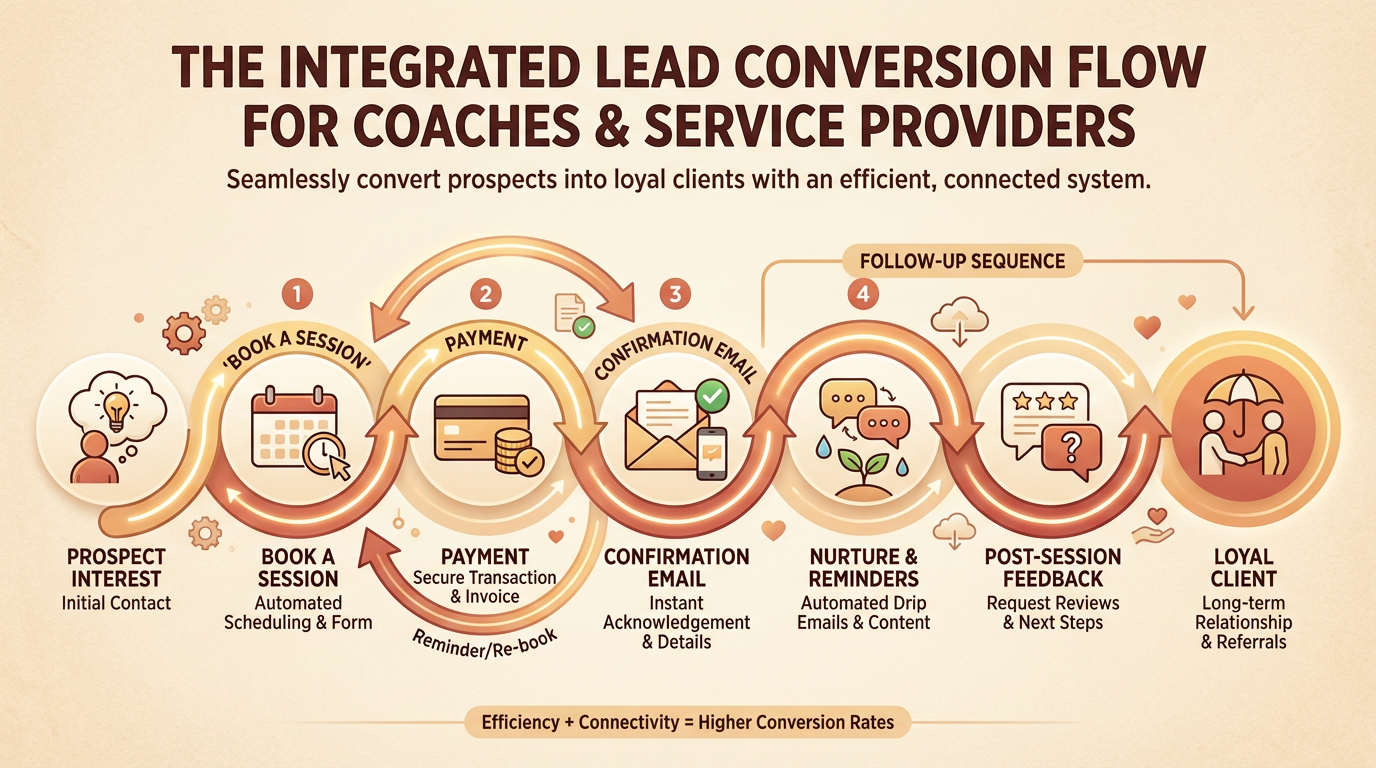
Here's what should happen when someone wants to work with you:
- They click a link to book a session
- They're taken to a calendar that shows your real availability
- They select a time
- They're prompted to pay
- Payment triggers an automatic confirmation email with session details
- Their contact information is added to your CRM
- They receive a reminder email 24 hours before the session
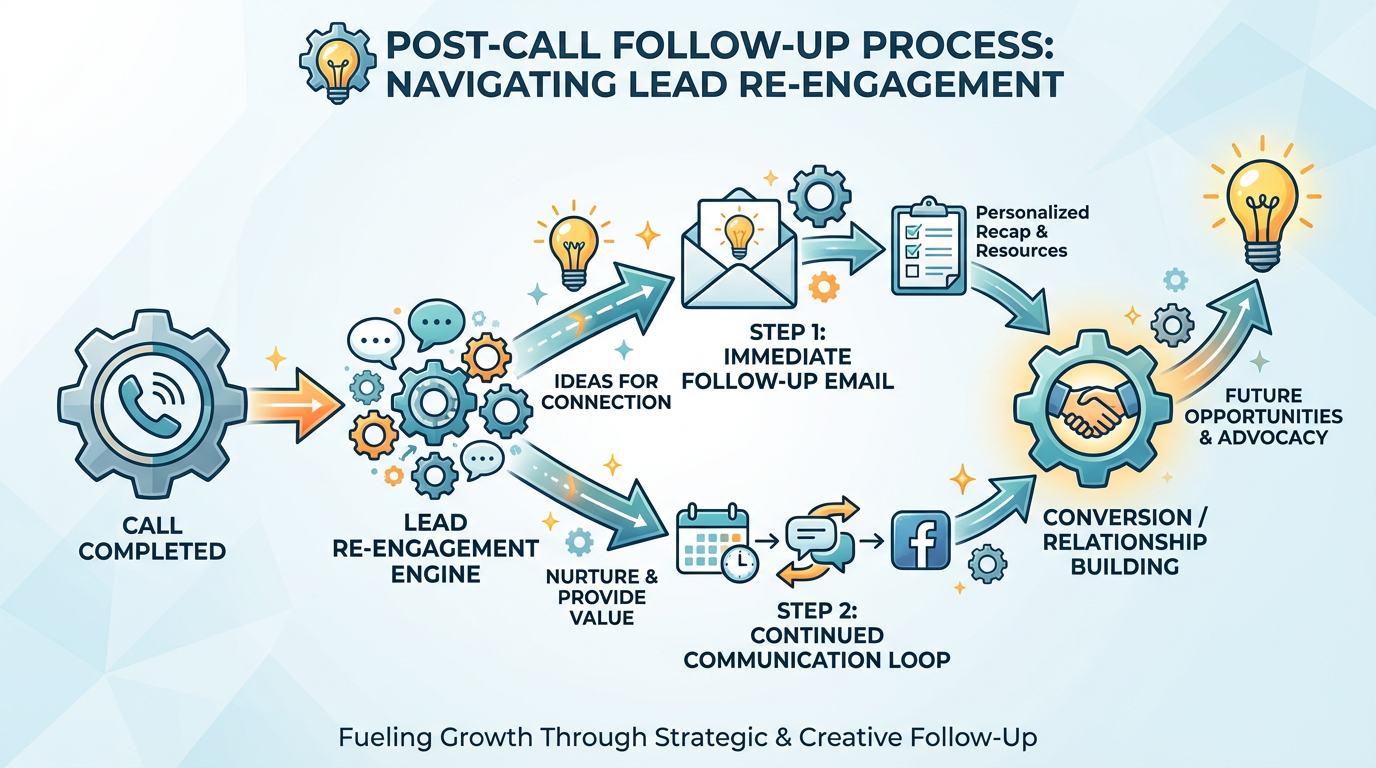
- After the session, they're added to a follow-up sequence for future offers
That's it. That's the baseline.
None of this requires a massive team or a six-figure tech stack. It requires choosing tools that talk to each other and setting them up correctly.
When your calendar, payment processor, email platform, and CRM are integrated, your clients have a seamless experience—and you're not manually managing every step.
You're not copying and pasting email addresses into spreadsheets. You're not wondering if someone paid. You're not chasing people down to book their session.
The system does that work for you.
And here's the bigger point: when your backend is clean, you can actually focus on delivery. You can show up fully for the clients you have instead of drowning in admin work for the clients you're trying to close.
Why "Too Many Leads" Can Be a Business-Killing Problem
This sounds counterintuitive, but it's true: high demand without operational capacity will destroy your business faster than no demand at all.
Here's why:
When you have more interest than you can handle and no systems to manage it, every new lead becomes a liability. You can't respond fast enough. You can't onboard people properly. You can't deliver quality service because you're buried in logistics.
Your clients have a bad experience. They don't refer others. They don't come back. And your reputation takes a hit—not because your core offer is bad, but because your operations are a mess.
This is the exact situation the coach in our transcript faced. Great lead generation. High demand. No backend infrastructure. The result? Confusion, overwhelm, and tens of thousands of dollars in lost revenue every month.
They weren't failing at marketing. They were failing at operations.
And that's the part most founders don't see coming. They think success is about getting noticed. But real success is about having the infrastructure to convert attention into income—and to do it repeatedly without losing your mind.
If you're drowning in interest but not growing revenue, the answer isn't better marketing. It's better systems.
What You Actually Need to Convert Leads Consistently
Let's make this practical.
If you're a coach, consultant, or service provider, here's the minimum viable infrastructure you need:
A scheduling tool that syncs with your calendar
No more back-and-forth emails about availability. Your clients should be able to see your open slots and book directly.
A payment processor that integrates with your scheduling tool
When someone books, they should be able to pay immediately. And that payment should trigger the next step automatically.
A CRM to track every client interaction
You need one place where you can see: Who inquired. Who paid. Who booked. Who needs follow-up. Who's a repeat client.
Automated email sequences for confirmation, reminders, and follow-up
Your clients should never wonder what happens next. And you should never have to manually send the same email 50 times.
A centralized communication system
Whether it's email, SMS, or a client portal, you need one place where all communication lives—not scattered across Instagram DMs, text threads, and email inboxes.
This isn't overkill. This is baseline business infrastructure.
And the reason most founders don't have it isn't because they don't know it exists. It's because they're moving so fast that they never stop to build it. They're too busy putting out fires to install a sprinkler system.
But here's the truth: you will never outgrow the need for systems. You'll only feel the pain of not having them more intensely as you scale.
The Real Cost of "Winging It"
Let's talk about what it actually costs to run a business without systems.
It's not just lost revenue—though that's significant. The coach we worked with was losing $50,000 per month in opportunities they couldn't convert. That's $600,000 per year left on the table.
But the hidden costs are just as damaging:
Reputation damage. When clients have a confusing or frustrating experience, they don't just leave quietly. They tell other people. They don't refer you. They don't come back for your next offer.
Founder burnout. When you're the system, you can't take a day off. You can't delegate. You can't grow. Every new client adds to your workload instead of your income.
Missed opportunities for scale. Without systems, you're stuck trading time for money. You can't build leveraged offers. You can't hire support. You can't create anything that runs without you.
Decision fatigue. When every client interaction requires you to figure out the next step manually, you're making hundreds of tiny decisions every week that should be automated. That's exhausting.
The entrepreneurs who scale aren't necessarily smarter or more talented. They just build infrastructure that allows their effort to compound instead of reset with every new client.
Systems aren't about removing the human touch. They're about removing the chaos so you can actually be present for the humans you're serving.
How to Stop Leaving Money on the Table
If you're reading this and recognizing your business, here's what to do:
Audit your current process from inquiry to payment. Map out every step a potential client has to take to work with you. Identify where people are dropping off. Find the friction points.
Choose tools that integrate with each other. Don't just add more apps. Build a connected ecosystem where information flows automatically from one tool to the next.
Automate confirmation and follow-up. If you're manually sending the same message more than twice, it should be automated.
Centralize client communication. Stop managing inquiries across five different platforms. Pick one system and funnel everything through it.
Test your own process as if you were a client. Book a session with yourself. Go through your payment process. See what the experience actually feels like. If it's confusing for you, it's definitely confusing for your clients.
This doesn't have to happen overnight. But it does have to happen intentionally.
Start with the biggest bottleneck. Fix that. Then move to the next one. You don't need perfect systems. You need functional ones that remove you from the repetitive, manual work so you can focus on growth and delivery.
Why This Matters More Than Your Next Marketing Campaign
Here's the part most coaches don't want to hear:
Your next launch won't fix this. Your next ad campaign won't fix this. Your next viral post won't fix this.
If your backend is broken, more visibility will only amplify the problem.
You'll attract more people you can't serve. You'll create more confusion. You'll burn out faster. And you'll wonder why success feels so hard when you're doing everything the gurus told you to do.
The answer is simple: marketing gets attention. Systems create clients.
You can have the best offer in the world, but if people can't easily buy it, book it, and experience it without friction, you're losing.
And the tragedy is that most of that loss is invisible. You don't see the people who bounced because your booking process was too confusing. You don't see the revenue that never materialized because follow-up was inconsistent. You don't see the referrals that didn't happen because the client experience felt chaotic.
You just see that you're working harder than ever and not seeing the results you expected.
That's the cost of ignoring operations.
The good news? This is fixable. You don't need a bigger team. You don't need a bigger budget. You need clarity about what's broken and a plan to fix it systematically.
And that's exactly what we help founders do.
[Book a Clarity Call[(https://allianceforbusiness.co/book) and we'll audit your current systems, identify where revenue is leaking, and show you exactly what needs to exist for your business to convert leads consistently—without adding more to your plate.
FAQ
Q: I'm just starting out. Do I really need all these systems right away?
You need the basics from day one: a way to schedule, a way to get paid, and a way to follow up. You don't need complex automation, but you do need a clear path from interest to payment. Waiting until you're overwhelmed to build systems means you're building under pressure—and that's when mistakes happen.
Q: What if I can't afford expensive software?
You don't need expensive software. You need integrated software. Many scheduling tools, CRMs, and email platforms have free or low-cost tiers that work perfectly for small businesses. The cost of not having systems is far higher than the cost of the tools themselves.
Q: I like the personal touch of handling everything manually. Won't automation make my business feel impersonal?
Automation doesn't replace the personal touch—it protects it. When you automate repetitive admin tasks, you have more time and energy to be present with clients during the interactions that actually matter. Your clients don't want you manually sending calendar invites. They want you focused and prepared when you show up for their session.
Q: How do I know which tools to use?
Start with what integrates. Don't pick tools in isolation. Choose a scheduling platform that connects to your payment processor and CRM. Most modern tools are built to work together—you just need to set them up correctly. If you're unsure, audit your process first and identify your biggest bottleneck. Fix that, then expand.
Q: What if I'm already drowning and don't have time to set up systems?
That's exactly why you need systems. The "I don't have time to fix this" loop is what keeps founders stuck. You'll never have more time until you create it by removing yourself from manual, repetitive work. Block a few hours, fix one bottleneck, and immediately you'll feel the difference. Or bring in someone who can build it for you while you keep serving clients.
Q: I have a CRM but I'm still losing leads. What's wrong?
Having a CRM doesn't help if it's not connected to your other tools or if you're not using it consistently. Most lead loss happens because there's no automated follow-up or because client information lives in multiple places. A CRM is only valuable if it's integrated into your workflow and actively managing your pipeline—not just storing names.
Q: Can I really convert leads consistently without spending more on ads?
Absolutely. Most founders don't have a traffic problem—they have a conversion problem. Fixing your backend systems can double your revenue without spending another dollar on marketing. When you stop losing leads to friction and confusion, the clients you're already attracting actually become paying customers.
Q: How long does it take to set up proper systems?
For most small businesses, you can have functional baseline systems in place within a week. It's not about perfection—it's about having the essentials connected and working. From there, you refine and optimize as you grow. The key is starting with clarity about what needs to happen and building intentionally, not reactively.